

Vending machine telemetry: 7 critical benefits for 2026
How remote monitoring shows sales, stock and faults in real time, and why it pays for itself in saved trips.
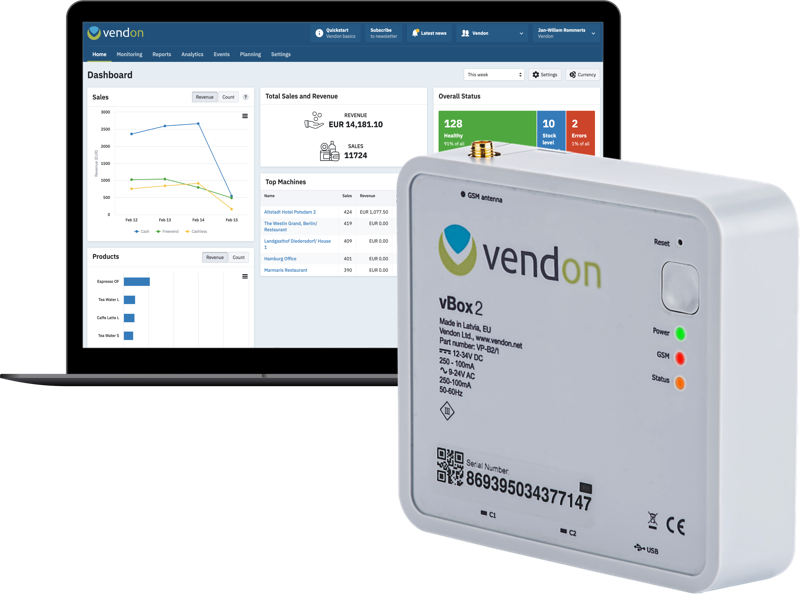
Vending machine telemetry lets you see what’s happening inside every machine without visiting it. Sales, stock levels, payments and faults all appear on your phone or laptop in near real time.
This guide explains how vending machine telemetry works, 7 critical benefits, what it costs, how to set it up and what to look for in a system.
Card-ready, connected machines
Telemetry and card payments for £10 a month plus 2% per transaction, with free UK delivery and installation.
View Machines For Sale →How vending machine telemetry works
A small device inside the machine connects to its control system and payment hardware. It records every sale, every coin and card payment, and any errors the machine reports.
The device sends that data over a mobile SIM to an online dashboard. You log in from a phone or computer to see sales, stock and alerts for each machine.
In many setups, the telemetry device and card reader come together. That’s why vending machine telemetry is often bundled with contactless payment.
Once it’s running, it works quietly in the background.
7 critical benefits of vending machine telemetry
Here’s what vending machine telemetry actually does for your business.
1. Know what’s in stock
See exactly which products are running low in every machine. No more driving to a site to find it’s still half full.
2. Plan smarter routes
Visit only the machines that need it, and bring exactly the right stock. Operators often cut wasted trips and fuel significantly.
3. Spot faults fast
Get alerts when a machine jams, a payment reader fails or a door is left open. Faster fixes mean fewer lost sales.
Some faults can even be diagnosed remotely, saving an engineer visit altogether.
4. Protect chilled stock
Temperature alerts warn you if a fridge stops cooling. That matters most for fresh food and chilled drinks machines.
5. Accept card payments
Telemetry usually comes with a card reader, so customers can pay by card, phone or watch. Our contactless vending machine guide explains why that lifts sales.
6. Understand what sells
Sales data by product, day and hour shows your best and worst lines. Swap slow sellers and price best sellers with confidence.
7. Simplify your admin
Exportable sales reports make commission statements, VAT records and accounts much quicker. Vending machine telemetry turns guesswork into clean data.
“Without telemetry, you find out a machine is empty when you get there. With it, you know before you leave home.”
What vending machine telemetry costs
At Irelley, telemetry with card payments costs £10 a month plus 2% per card transaction. There’s no need to buy a separate system.
For most operators, vending machine telemetry pays for itself quickly through fewer wasted trips and less lost stock. Our vending machine profit calculator helps you model the savings.
Compare it with the cost of a single unnecessary round trip each week. Fuel, time and missed sales add up far faster than a monthly fee.
With Telemetry
Connected Machine
- Stock levels: Visible remotely
- Faults: Instant alerts
- Payments: Card, phone and coin
- Routes: Planned around real demand
- Reporting: Automatic
Without Telemetry
Offline Machine
- Stock levels: Only seen on site
- Faults: Found on the next visit
- Payments: Often coin only
- Routes: Fixed schedules
- Reporting: Manual counting
Setting up telemetry
Setting up vending machine telemetry is usually simple. The device is fitted inside the machine, connected to its payment port and power, and activated on the provider’s platform.
Before installing, check mobile signal at the exact spot the machine will stand. Ofcom’s mobile coverage checker gives a quick idea, but test on site too, especially in basements and metal buildings.
Many older machines can be retrofitted, as long as they have a compatible payment port. Our contactless payment setup guide explains the retrofit process.
Common problems and fixes
Weak signal is the most common issue. If vending machine telemetry keeps dropping out, try an external antenna, move the machine slightly or ask about a different network SIM.
Data that doesn’t match the machine is the second. It usually means products were loaded into the wrong slots, so update your planogram whenever you change the range.
Missed alerts are the third, and they undo much of the value of vending machine telemetry. Set up notifications on your phone, and decide who responds to each type of alert. Our guide to vending machine maintenance covers what to do when a machine reports a fault.
Using the data well
Vending machine telemetry data only helps if you act on it. Set aside time each week to review sales, stock and alerts across your machines.
Look for patterns: which machines sell most on which days, which products sell out first, and which sit untouched. Our guide to how much vending machines make shows what good looks like. Adjust planograms and restocking schedules accordingly.
Our guide on how to restock a vending machine shows how to turn sales data into an efficient restocking routine.
Our take: vending machine telemetry is one of the best-value upgrades in vending. For £10 a month plus 2%, you get card payments, real-time stock and fault alerts that pay for themselves in saved trips.
Security and cash reconciliation
Vending machine telemetry records every coin and card sale, so you can check that cash collected matches what the machine says it took. Gaps show up quickly.
Door-open alerts outside normal hours can warn of tampering or theft. Combined with cashless payment, telemetry makes machines a much less attractive target.
For multi-site operators with staff collecting cash, this reconciliation is one of the strongest reasons to use vending machine telemetry.
Pricing and promotions
Sales data shows exactly how customers respond to price changes. Test a small rise on best sellers, or a discount on slow lines, and watch the results.
Some systems support time-based offers, such as cheaper coffee early in the morning. Vending machine telemetry makes it easy to see whether a promotion pays its way.
Telemetry for different machine types
Every machine benefits from vending machine telemetry, but some benefit more than others.
Fresh food machines
Temperature alerts and sell-by tracking cut waste. A fresh produce machine with telemetry is far easier to run safely.
Touchscreen combo machines
Modern touchscreen machines often integrate telemetry tightly, showing product information and promotions too. Our grey combo with touchscreen is one example.
Remote and outdoor machines
Machines far from your base save the most travel. Vending machine telemetry tells you exactly when a long trip is worth it.
Scaling a vending route with telemetry
Running two or three machines without data is manageable. Running twenty is not, which is why vending machine telemetry becomes essential as a route grows.
With every machine reporting in, you can plan one efficient run a day instead of visiting each site on a fixed schedule. Pre-pick stock at base so each stop takes minutes.
Data also shows which sites earn their place. Move underperforming machines to better locations, and use the figures to win new sites, as our guide to the best vending machine locations explains.
Choosing a telemetry system
When comparing systems, look at what’s included, not just the price. Check for:
- Real-time stock and sales data: by product and machine
- Alerts: faults, temperature and door-open warnings
- Payment support: contactless cards, Apple Pay and Google Pay
- Reporting: easy exports for accounts and commission
- Mobile app: so you can check machines on the go
Our guide to cashless vending payment covers the payment side in more detail.
For businesses running their own machine
You don’t need to be an operator to benefit. A business running its own staff machine can use vending machine telemetry to see what people buy and when to reorder.
It also shows whether the machine is valued. Clear usage figures help justify the machine to management, or support a decision to subsidise popular items.
Data, privacy and security
Telemetry systems record sales and machine data rather than personal details, and card payments are handled by the payment provider. Even so, choose a reputable system and protect your login with a strong password.
Limit dashboard access to the people who need it, such as route staff and your accountant. If someone leaves, remove their access straight away.
Keep regular exports of your data. If you ever switch provider, having your own sales history makes the move much easier.
Telemetry and site owners
If you pay commission, telemetry data makes statements accurate and transparent. Site owners trust figures they can see, which helps when renewing agreements.
Our commission rates guide explains how to share sales data as part of a fair deal.
Buying from Irelley
Browse our vending machines for sale, then contact our team to add card payments and vending machine telemetry. We deliver and install free anywhere in the UK, within 24 hours.
Every machine comes with a 12-month warranty covering parts and remote support, and our payment plans let you spread the cost at 0%.
FAQ
Frequently asked questions
Vending machine telemetry is remote monitoring. A connected device sends sales, stock, payment and fault data from the machine to an online dashboard or app.
At Irelley, telemetry with card payments costs £10 a month plus 2% per card transaction.
Usually not. Most systems use a built-in mobile data SIM, so you just need decent mobile signal where the machine stands.
Often, yes. Many telemetry and card reader devices connect through standard payment ports found on most commercial machines. Check compatibility first.
Even with one machine, it saves wasted trips and shows exactly what sells. For operators with several machines, the savings in time and fuel are usually significant.
Connect your machines
Card payments and telemetry for £10 a month plus 2%, with free UK delivery and installation.
[…] guides to vending machine telemetry and vending machine contactless payment UK explain how both […]